
Mingo County Release Date Meaning
A projected date is the agency's present calculation of when a term may reach a release point. An actual release is the dated custody transaction showing that the person left a named facility. Those facts can diverge. A calculation may change before release, and a person may leave one facility through transfer rather than return to the community. For someone arrested in Mingo County, Southwestern Regional Jail and Correctional Facility is the usual regional custodian. It sits in Holden and is run by the West Virginia Division of Corrections and Rehabilitation, so the Mingo County Sheriff is not the keeper of the jail time sheet.
Pretrial detention follows a different path. A defendant waiting for court action does not have a sentence endpoint to calculate. Bond, dismissal, a plea, a new order, or a hold from another authority can control when custody changes. A short jail sentence depends on the signed order, credited presentence days, and the facility's calculation. A state-prison sentence uses the prison record and WVDCR time sheet. These systems should not be blended into one date.
Find Mingo County Projected Dates
Begin by naming the custody system. The official WVDCR Offender Search gateway separates Daily Incarcerations, the regional-jail search, and the prison search. A Mingo arrest held at Southwestern belongs in the jail system. A person committed to a state term belongs in the prison system. Daily Incarcerations is an admission or active-custody view, not a release-date tool. For either search, confirm identity with the OID or date of birth where displayed. A matching name alone can point to the wrong person.
The prison “More Info” record may show a projected release date, along with status, sentence, parole eligibility, or discharge-related data. Use the exact label on the live record. “Projected release date,” “minimum discharge,” and “parole eligibility date” describe different milestones. If the public record lacks the date or conflicts with a court order, ask WVDCR for the time sheet, the minimum-discharge statement, and all revisions. The broader Mingo County released-inmate search explains how the jail event, court order, and custody status work together.
A practical sequence keeps those records aligned:
- Identify whether the person is pretrial, serving a regional-jail sentence, or committed to state prison.
- Search the official WVDCR jail system for Southwestern custody or the WVDCR prison system for a state term.
- Write down the exact status and date labels, plus the OID, case number, institution, and sentence details shown.
- Obtain the signed Mingo court order and jail-credit order from the proper clerk when the sentence basis is unclear.
- Request the WVDCR time sheet and revised minimum-discharge statement if a date is missing or disputed.
Note: A blank regional-jail search does not prove release because the person may have transferred, the data may have changed, or the name may not match.
Mingo County Good-Time Calculations
The controlling court orders come first. WVDCR uses the sentence type and term, concurrent or consecutive structure, sentence start, and credited jail days to build the time sheet. Under West Virginia Code §15A-4-17, an eligible person earns one day of good time for each day physically incarcerated, including presentence jail days that the sentencing court credits. The deduction is applied to the maximum term of an indeterminate sentence or the fixed term of a determinate sentence. No good time accrues while a person is on parole, bond, or another non-incarcerated status.
Eligibility has limits. Life sentences receive no good time under the general section. Consecutive eligible sentences are combined for the calculation. A disciplinary violation can forfeit some or all credited time, while the superintendent, with Commissioner approval, can restore it. Approved meritorious service and certain nonrequired academic or vocational programs may produce extra credit within the statute's limits. Each loss or restoration that moves the earliest discharge calls for a revised statement.
West Virginia does not have a general rule requiring all people in state custody to serve about 85 percent of a sentence. That federal shorthand should not be imported into a Mingo County calculation. Offense-specific minimums, statutory exclusions, and the wording of the actual sentence still matter. A rough arithmetic example cannot predict a named person's date. The official good-time and minimum-discharge statute shows the provisions used in the calculation.
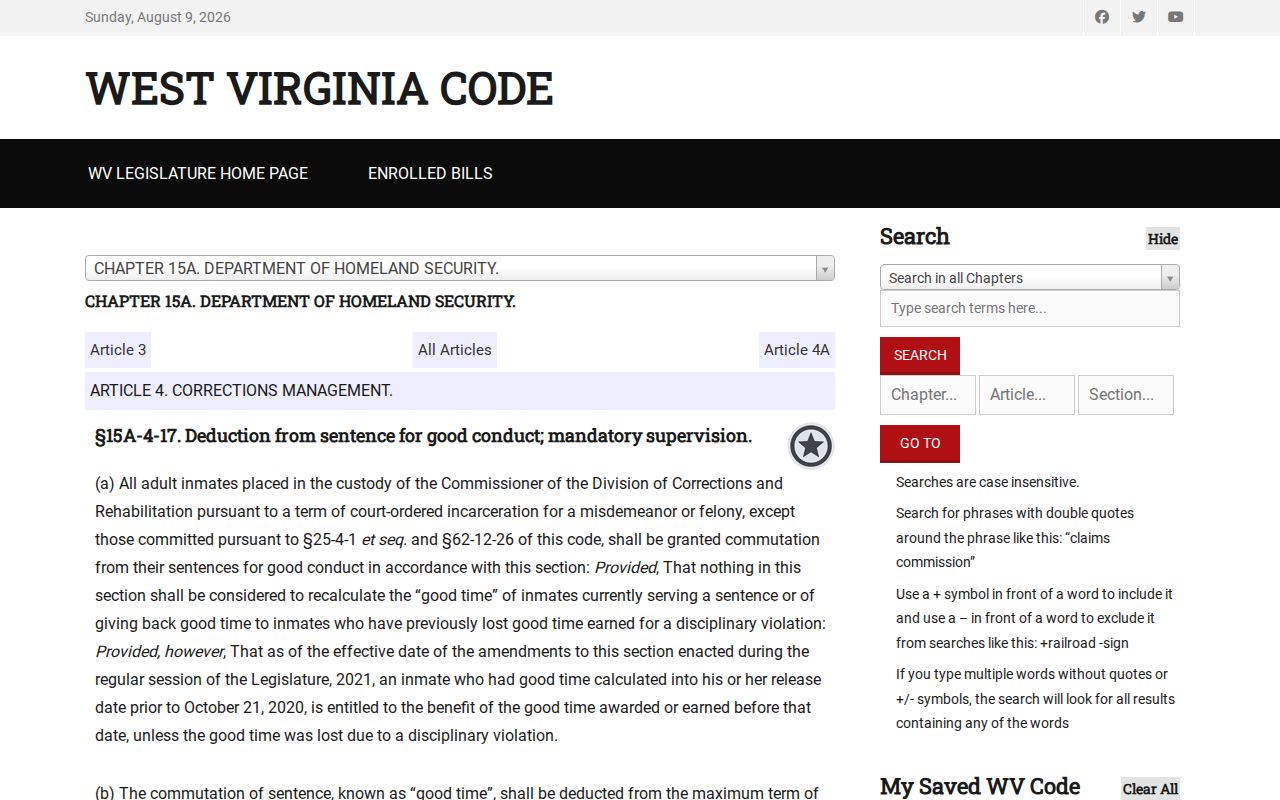
The statute view is most useful beside the court order and WVDCR time sheet, since the law supplies the rules while those records supply the person-specific inputs.
Mingo County Release Date Changes
A projected date can move in either direction. New credit or restored good time may bring an eligible discharge point closer. Lost good time, a corrected jail-credit total, or a sentence amended to run consecutively may move it later. A detainer is a request or legal basis for another authority to take custody. It may prevent community release even when the current term reaches its endpoint. Likewise, a court order can change the legal basis while WVDCR updates its calculation.
Parole and mandatory supervision require careful labels. Parole eligibility date, often shortened to PED, is the first point at which the Parole Board may consider release. It is not a guaranteed interview or exit date. Mandatory supervision may place a person outside the facility before the final sentence endpoint, but the person remains under stated controls. The record should say whether a date marks eligibility, physical release, minimum discharge, or final discharge.
| Factor | Possible effect | Best record to check |
|---|---|---|
| Jail credit | Changes the credited start or time already served | Sentencing and jail-credit orders |
| Good-time loss or restoration | Moves the earliest eligible discharge | Revised WVDCR minimum-discharge statement |
| Concurrent or consecutive terms | Changes how multiple sentences combine | Controlling judgment and WVDCR time sheet |
| Detainer or hold | May send the person to another custodian | Movement record and receiving-agency record |
| Parole action | May create a supervised release path | Board outcome plus actual WVDCR release event |
Note: The WVDCR date should be read with its label, because a PED, projected release, and minimum discharge do not mean the same thing.
Mingo County Parole Grant Timing
Mingo County has a distinct regional-jail timing issue. The West Virginia Parole Board FAQ says a person granted parole while in a regional jail first transfers to a DCR facility for intake and fingerprinting. The Board advises anticipating about seven to ten days before actual parole release. A grant date, a transfer date, and the date the person reaches the community can therefore be three separate milestones.
“Granted” describes a Board outcome, not proof that the person left Southwestern that day. The transfer is also not community release. Check the prison record after the regional-jail record changes, then look for the actual custody event through WVDCR or VINE. Parole begins a period of executive supervision and does not equal final discharge from the sentence.
The official Parole Board guidance is the source for this regional-jail interval.
The guidance helps explain why a release alert or custody change can follow the Board decision rather than occur at the same moment.
Mingo County Sentence Records
When the date is disputed, gather records from both the legal and custody sides. The Mingo court holds the judgment, commitment, jail-credit order, modification, or revocation that authorizes the sentence. WVDCR holds the booking file, time sheets, sentence calculations, and minimum-discharge statements used to administer it. A court order can show what should be calculated, while the revised WVDCR statement shows how the agency applied credit and good-time changes.
West Virginia Code §15A-4-17 requires a statement of sentence length and minimum discharge for a person placed in the Commissioner's custody, including someone returned for a parole or supervised-release violation. It also requires a revision when lost good time is revoked or restored and the earliest discharge changes. Ask for every revision, not only the current total, if the history matters. For an order error, the Parole Board points readers to counsel or the circuit clerk. For a time-sheet or minimum-discharge issue, the institutional records and WVDCR side is the correct route.
The West Virginia Magistrate Record Search can supply a Mingo case-number lead by name or case number, but it returns no document images and caps results at 30. Obtain the signed magistrate order from the Mingo Magistrate Clerk. Circuit felony judgments, later sentence orders, and revocation matters belong with the Mingo Circuit Clerk. Search by case number when possible, since it connects the order to the correct WVDCR booking more reliably than a common name. If a new order credits time or changes the sentence structure, compare its entry date with the issue date on the next WVDCR calculation. That timeline can show why an earlier projected release date was revised.
- Projected release date
- The current calculated date displayed or maintained from available sentence data.
- Minimum discharge
- The statutory sentence calculation WVDCR must state and revise when qualifying credits change.
- Parole eligibility date
- The date consideration may begin, not a promised release date.
- Detainer
- A hold or request that can lead to continued custody under another authority.
Confirm Mingo County Release Dates
Final confirmation should match the date to an event. Search the prison record again near the projected point and note the exact status. Check the individual through the VINELink Release Check for a custody alert, but do not treat a transfer notice as freedom from custody. VINE is a prompt notification channel, not the signed court file or certified WVDCR release transaction.
For a Southwestern case, call the facility at 304-239-3032 for navigation and current-status questions, then request the dated release or movement record if formal proof is needed. For a state-prison calculation, request the time sheet, minimum-discharge statement, revisions, and actual release event from WVDCR. For a pretrial Mingo case, obtain the bond, dismissal, or other controlling order from the Mingo clerk and pair it with the physical custody event. That pairing answers both why release was authorized and when it occurred.
A later supervision record may still be needed. Parole, probation, or mandatory supervision means the person is outside the facility under conditions. Final discharge is a later endpoint. The cleanest date record identifies all three facts: the facility left, the event date, and whether custody or supervision continued.